Understanding Embeddings in AI
According to a report by Unite.ai, understanding embeddings is fundamental to grasping how modern artificial intelligence systems process and represent semantic meaning. Because neural networks cannot natively read or understand human language, images, or audio in the way people do, they rely on embeddings to translate complex data into numerical values.
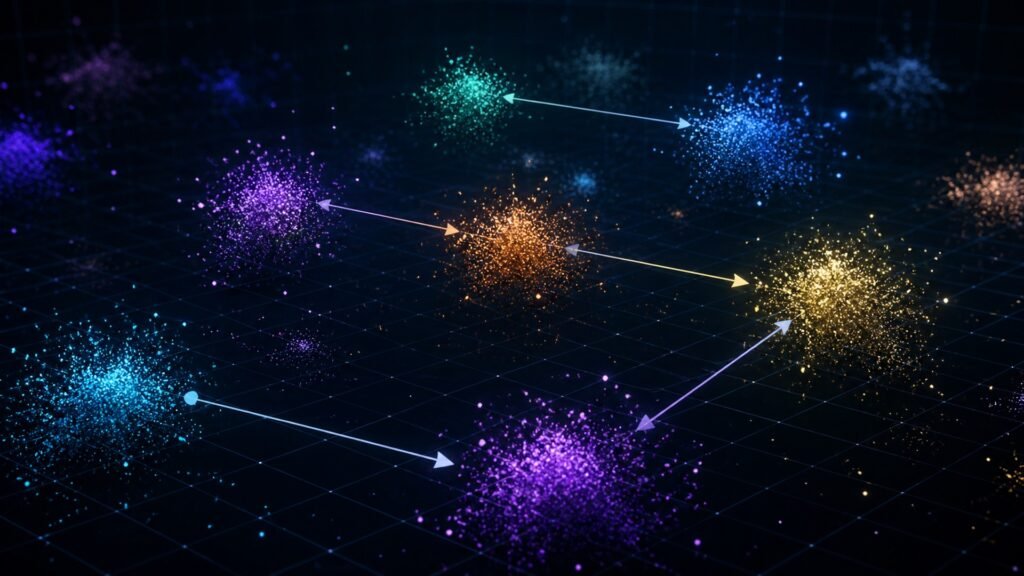
As detailed by Unite.ai, embeddings function by mapping words, sentences, or entire media objects into high-dimensional vector spaces. In this spatial representation, items that share similar meanings or contexts are positioned closer together. This mathematical proximity allows generative AI models, search engines, and recommendation systems to compute relationships, perform semantic searches, and generate contextually relevant outputs.
The underlying mechanics convert qualitative information into quantitative coordinates, enabling algorithms to calculate mathematical distances between distinct concepts. For the AI creative and media desk, vector embeddings serve as the foundational architecture behind multimodal systems that bridge text, image, and audio generation. By translating conceptual meaning into numerical coordinates, models can seamlessly synthesize and retrieve creative assets based on semantic similarity rather than simple keyword matching.
Based on reporting by www.unite.ai.